
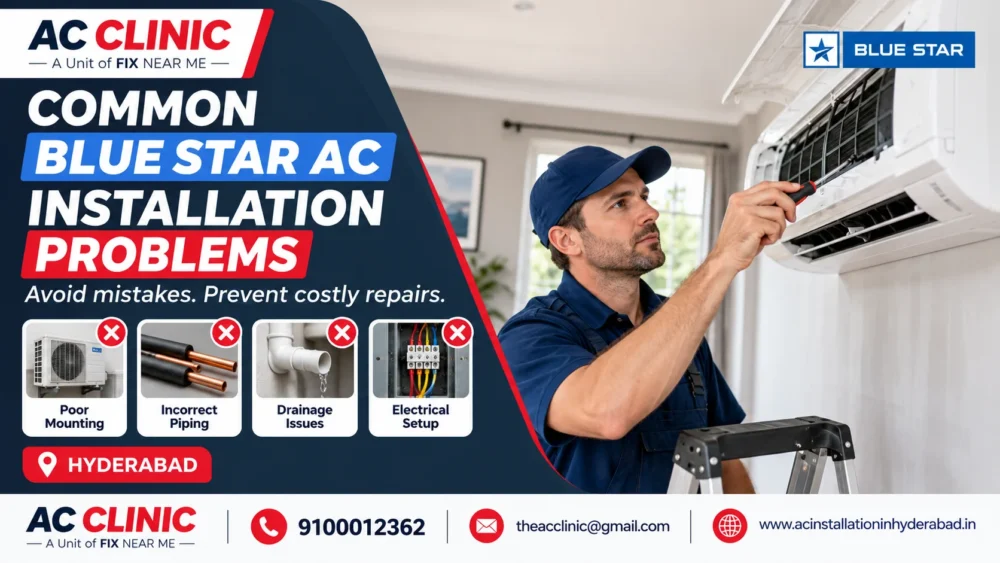
Common Blue Star AC Installation Problems: Causes, Warning Signs & Prevention
Installing an air conditioner correctly is essential for reliable cooling, proper airflow and safe operation. Even a good-quality Blue Star AC can experience problems when the indoor or outdoor unit is incorrectly positioned, refrigerant connections are not properly installed, electrical requirements are overlooked or condensate drainage is inadequate.
Some problems become noticeable immediately after installation, while others appear after the air conditioner has operated for some time.
Understanding these installation-related issues can help homeowners and businesses identify warning signs early, ask the right questions during installation and avoid unnecessary repair expenses.
This guide explains common Blue Star AC installation problems, their possible causes, what customers can safely observe and when professional inspection is necessary.
1. Incorrect Indoor and Outdoor Unit Placement
Incorrect positioning of the indoor or outdoor unit can affect airflow, cooling distribution, accessibility and overall system operation.
Common installation mistakes
- Installing the indoor unit where furniture or other obstructions restrict airflow.
- Positioning the outdoor unit in a confined space.
- Blocking the outdoor unit’s air intake or discharge.
- Mounting the indoor unit on an unsuitable or weak wall.
- Providing insufficient clearance for future maintenance.
- Selecting a location that makes refrigerant piping and drainage difficult.
Possible warning signs
- Uneven cooling in different parts of the room.
- Restricted airflow.
- Excessive outdoor-unit operating noise.
- Difficulty accessing the equipment for maintenance.
How to prevent the problem
The installation position should be selected according to the manufacturer’s instructions for the particular AC model.
Before installation, confirm that:
- The indoor unit has sufficient airflow clearance.
- The outdoor unit has adequate ventilation.
- The mounting surface can safely support the equipment.
- The installation location allows maintenance access.
- The connecting pipes and drainage route can be installed appropriately.
Avoid covering or enclosing the outdoor unit without checking the manufacturer’s requirements.
2. Improper Refrigerant Pipe Installation
Split air conditioners use refrigerant piping to transfer heat between the indoor and outdoor units.
Incorrect piping installation can contribute to refrigerant leakage, insulation problems and reduced cooling performance.
Common causes
- Poorly made flare connections.
- Incorrectly tightened pipe connections.
- Damaged copper tubing.
- Inadequate pipe insulation.
- Incorrect pipe routing.
- Failure to follow model-specific installation procedures.
Possible warning signs
- Reduced cooling performance.
- Ice formation on certain components.
- Unusual operating behaviour.
- Refrigerant leakage suspected during professional inspection.
These symptoms do not independently confirm a refrigerant leak. Other faults can produce similar problems.
How to prevent the problem
A qualified installation professional should:
- Select piping according to the AC manufacturer’s specifications.
- Check copper pipes for visible damage.
- Make connections using the appropriate installation procedure.
- Ensure the piping insulation is properly fitted.
- Perform the required leak-testing procedure.
- Complete evacuation and commissioning according to the manufacturer’s instructions.
Important: Customers should not loosen refrigerant connections, handle refrigerant or attempt to refill the system themselves.
3. Incorrect Electrical Connections
Electrical installation is an important part of air conditioner commissioning. Incorrect electrical connections can create operational problems and potential safety hazards.
Common electrical installation problems
- Unsuitable power-supply arrangements.
- Incorrect cable selection.
- Improper earthing.
- Loose electrical connections.
- Incorrect protective-device selection.
- Wiring that does not comply with the model’s electrical specifications.
Warning signs
Watch for:
- Repeated circuit-breaker tripping.
- Burning smells.
- Unusual electrical noises.
- Unexpected shutdowns.
- Visible damage to accessible cables or plugs.
How to prevent electrical installation problems
Electrical connections must be completed by an appropriately qualified professional.
The installer should verify:
- The electrical supply requirements of the specific model.
- Suitable cable specifications.
- Proper earthing.
- Appropriate circuit protection.
- Secure electrical terminations.
- Compliance with applicable electrical safety requirements.
Do not open electrical panels, touch internal wiring or attempt live electrical testing.
If you notice a burning smell, sparking or repeated breaker trips, stop using the AC and arrange professional inspection.
4. Incorrect Condensate Drainage Installation
During cooling operation, an air conditioner removes moisture from indoor air. This moisture collects as condensate and must drain away correctly.
Incorrect drainage installation can cause water leakage around the indoor unit.
Common drainage mistakes
- Incorrect drain-pipe slope.
- Kinked or obstructed drainage pipes.
- Loose drain connections.
- Poorly routed drain pipes.
- Incorrect drain outlet positioning.
- Inadequate drainage testing after installation.
Possible warning signs
- Water dripping from the indoor unit.
- Moisture around the AC mounting area.
- Water stains on nearby walls.
- Persistent dampness near the drainage outlet.
How to prevent drainage problems
During installation, the drainage arrangement should be checked for:
- Appropriate downward fall.
- Secure pipe connections.
- Proper routing without unnecessary obstructions.
- Suitable drainage discharge location.
- Successful drainage testing.
If water leaks from the indoor unit, switch off the AC and arrange inspection. Avoid dismantling the indoor unit to investigate the drain system.
5. Improper Outdoor Unit Mounting
The outdoor unit contains important operating components and must be installed on a suitable support.
Poor mounting can contribute to vibration, noise and mechanical stress.
Common mounting problems
- Weak or unsuitable support brackets.
- Incorrect mounting arrangements.
- Loose fasteners.
- Inadequate clearance.
- Poor positioning of the outdoor unit.
- Insufficient attention to vibration isolation.
Warning signs
- Excessive vibration.
- Unusual rattling sounds.
- Movement of the mounting support.
- Unusual operating noise.
Prevention
The outdoor unit should be secured using a suitable mounting arrangement designed for its weight and installation location.
The installer should verify mounting stability, ventilation clearance and accessibility.
If the outdoor unit appears unstable, do not attempt to tighten or reposition it yourself. Arrange professional inspection.
6. Inadequate Post-Installation Testing
Completing the physical installation does not necessarily mean the air conditioner is ready for normal operation.
The system should undergo appropriate commissioning and operational checks.
Important post-installation checks
A professional installation inspection should consider:
- Indoor and outdoor unit mounting.
- Refrigerant piping connections.
- Pipe insulation.
- Electrical connections and earthing.
- Condensate drainage.
- Outdoor-unit airflow clearance.
- Cooling operation.
- Unusual vibration or noise.
- Remote-control operation.
- Relevant manufacturer-specific commissioning requirements.
The installer should also explain basic operating controls and maintenance requirements.
Safe Checks Customers Can Perform After Installation
Customers can observe some external conditions without opening the equipment.
Check | What to observe |
Cooling mode | Confirm that the remote is set to the intended operating mode |
Temperature setting | Check that the selected temperature is appropriate |
Airflow | Make sure curtains and furniture do not obstruct airflow |
Air filter | Follow the model manual for routine filter cleaning |
Outdoor unit | Observe whether its external airflow path is obstructed |
Drainage | Look for visible water leakage around the indoor unit |
Noise | Note unusual sounds or excessive vibration |
Switch off the AC before performing basic external observations where appropriate.
Do not handle electrical components, refrigerant pipes, internal motors or capacitors.
How to Avoid Costly Blue Star AC Installation Problems
A few precautions before and immediately after installation can help prevent avoidable problems.
1. Check the installation requirements
Read the installation instructions supplied with your particular Blue Star model.
Different models may have different clearance, piping and electrical requirements.
2. Confirm the installation scope
Before work begins, clarify what the installation quotation includes.
Ask about:
- Standard copper-pipe length.
- Additional piping charges.
- Drainage pipe requirements.
- Outdoor-unit support.
- Electrical cable requirements.
- Wall drilling and additional civil work.
- Additional installation materials.
3. Confirm the service provider’s status
If you intend to use Blue Star’s official standard installation offering, check the applicable terms and whether the service is being carried out by an authorised Blue Star Service Partner.
Do not assume that every independent AC installation provider is manufacturer-authorised.
4. Request appropriate testing
Ask the installer to explain which installation and commissioning checks have been completed.
5. Keep installation documentation
Retain the installation invoice, product details, warranty information and service documentation.
These records can be useful if an installation-related issue occurs later.
When Should You Arrange Professional Inspection?
Professional inspection is advisable when you notice:
- Poor cooling immediately after installation.
- Water leakage from the indoor unit.
- Repeated circuit-breaker tripping.
- Burning smells or electrical abnormalities.
- Excessive outdoor-unit vibration.
- Suspected refrigerant leakage.
- Unusual operating noise.
- Persistent shutdowns or error indications.
A technician should inspect the equipment before concluding that an installation mistake is responsible.
Some symptoms may originate from component faults, electrical supply problems, incorrect operating settings or other underlying causes.
Frequently Asked Questions
1. What are the most common Blue Star AC installation problems?
Common installation-related problems include incorrect unit placement, poorly installed refrigerant piping, electrical connection issues, drainage defects and inadequate outdoor-unit mounting.
2. Why is my Blue Star AC not cooling properly after installation?
Possible reasons include incorrect operating settings, restricted airflow, installation-related piping issues or equipment faults. The actual cause requires appropriate inspection.
3. Can incorrect AC installation cause water leakage?
Yes. Incorrect condensate drain routing, inadequate slope, loose connections or obstructions can contribute to water leakage from the indoor unit.
4. Can improper refrigerant piping affect AC cooling?
Yes. Incorrect connections, damaged piping or inadequate insulation can affect system operation. Refrigerant-related problems require professional diagnosis.
5. Does outdoor-unit placement affect AC performance?
Yes. Insufficient ventilation clearance or blocked airflow around the outdoor unit can affect heat rejection and system operation. Follow the manufacturer’s installation requirements.
6. Should electrical installation be performed by the customer?
No. Electrical connections, earthing and protective-device selection should be handled by an appropriately qualified professional.
7. How can I check whether my AC installation was completed properly?
Ask for confirmation of mounting stability, drainage testing, electrical safety checks, refrigerant piping inspection and the applicable commissioning procedure.
8. Should I contact Blue Star if a problem occurs immediately after installation?
You can contact Blue Star through its official service-support channels, particularly if you need manufacturer assistance or warranty-related clarification.
Need Assistance With AC Installation?
Correct installation is important for the safe and reliable operation of your air conditioner.
If you need assistance with Blue Star AC installation in Hyderabad, you can check the availability of professional doorstep installation assistance before booking.
AC Clinic is a service brand of FIX NEAR ME providing doorstep AC services in Hyderabad and applicable service areas. Service availability should be confirmed for your location before booking.
Contact and booking: Use the website’s current contact or booking facility to enquire about installation assistance and applicable service availability.
Editorial note: Manufacturer authorization, certification, warranty coverage, installation prices and locality availability should be confirmed before making any specific claims about the service provider.