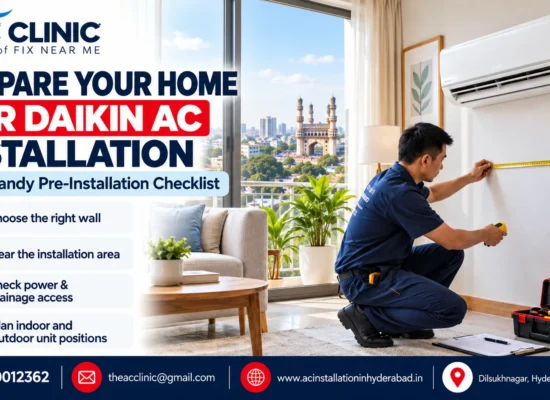


Why Professional AC Installation Matters in Hyderabad’s Extreme Heat
Hyderabad’s summer conditions place considerable demands on residential and commercial air-conditioning systems. When an air conditioner is installed incorrectly, the problem may become noticeable through inadequate cooling, unusual noise, water leakage, excessive energy consumption or repeated operating issues.
Choosing an appropriate air conditioner is only one part of achieving comfortable indoor temperatures. The installation also matters. Correct positioning, secure mounting, suitable piping, proper drainage and safe electrical connections all contribute to reliable operation.
In this guide, we explain why professional AC installation matters in Hyderabad, what installation factors homeowners should understand and what to check before accepting a newly installed air conditioner.
1. Why AC Installation Quality Matters During Hyderabad Summers
During hot weather, air conditioners may operate for extended periods. An installation that does not follow the manufacturer’s specifications can affect system performance and reliability.
Some installation-related problems include:
- Restricted airflow around the indoor or outdoor unit.
- Poorly insulated refrigerant piping.
- Incorrect drainage arrangements.
- Insecure indoor or outdoor unit mounting.
- Unsuitable electrical connections.
- Refrigerant leakage or incorrect system commissioning.
These problems do not always have the same symptoms or causes. A professional inspection is necessary to identify the actual issue.
2. Correct Indoor and Outdoor Unit Placement
The location of an air conditioner influences airflow, accessibility and operating conditions.
Indoor unit placement
The indoor unit should be positioned according to the manufacturer’s installation instructions.
Important considerations include:
- Adequate clearance around the unit.
- Unobstructed airflow into and out of the AC.
- A suitable position for distributing conditioned air throughout the room.
- Accessibility for routine filter cleaning and maintenance.
- Appropriate wall strength and mounting support.
Avoid positioning the unit where curtains, furniture or other obstructions restrict airflow.
Outdoor unit placement
The outdoor unit requires adequate ventilation and secure support.
Installation planning should consider:
- Manufacturer-specified ventilation clearances.
- A stable mounting surface or suitable bracket.
- Accessibility for inspection and maintenance.
- Proper protection of refrigerant piping and connections.
- Appropriate drainage arrangements.
The outdoor unit should not be enclosed in a way that restricts airflow.
3. Why Refrigerant Piping and Insulation Matter
Split air conditioners use refrigerant piping to connect the indoor and outdoor units.
Incorrect pipe routing, unsuitable insulation or poorly executed connections can contribute to system performance problems.
Professional installation should account for:
- Manufacturer-specified pipe diameter.
- Permitted piping length and height difference.
- Proper insulation of refrigerant lines.
- Secure and correctly executed connections.
- Appropriate leak testing and evacuation procedures.
- Refrigerant charging according to the manufacturer’s specifications.
Refrigerant handling and pressure testing should be performed by appropriately qualified personnel using suitable equipment.
Homeowners should not attempt to open refrigerant connections or handle refrigerant themselves.
4. Electrical Safety During AC Installation
Air conditioners require electrical connections appropriate to their model and rated operating requirements.
Incorrect electrical work can create serious safety hazards, including electric shock, overheating and fire.
A professional installation should account for:
- Suitable electrical supply capacity.
- Appropriate circuit protection.
- Correct earthing and grounding.
- Secure electrical connections.
- Compliance with applicable electrical requirements.
- Manufacturer installation instructions.
Electrical connections and modifications should be handled by qualified personnel.
Never attempt to open the AC electrical compartment or modify internal wiring as a DIY installation activity.
5. Proper Condensate Drainage
Air conditioners remove moisture from indoor air during cooling.
This moisture must be directed safely through the condensate drainage arrangement.
Incorrect drain positioning, poor routing or blockages can contribute to water leakage.
During installation, the drainage arrangement should be checked for:
- Suitable drainage direction.
- Correct pipe routing.
- Secure connections.
- Appropriate slope according to manufacturer instructions.
- Unobstructed discharge.
After installation, homeowners can observe whether water leakage is occurring around the indoor unit. If leakage is noticed, switch off the equipment and arrange a professional inspection.
6. Split AC and Window AC Installation Requirements
Different air-conditioning systems have different installation requirements.
Consideration | Split AC | Window AC |
Main installation requirement | Indoor and outdoor unit positioning | Suitable window or wall opening |
Mounting | Indoor bracket and outdoor support | Stable frame and secure fitting |
Drainage | Condensate drain piping | Manufacturer-specified drainage arrangement |
Electrical work | Suitable supply and connections | Suitable electrical supply |
Important consideration | Refrigerant piping and insulation | Secure fitting and correct drainage |
The exact requirements depend on the AC model and its installation manual.
7. What Hyderabad Homeowners Should Consider Before Installation
Before arranging an AC installation, consider the following factors.
Room size and cooling requirements
The AC capacity should be appropriate for the room and its cooling requirements.
Room dimensions, sunlight exposure, occupancy, ceiling height and heat-generating equipment can all influence cooling demand.
Building structure
Wall strength, installation height, outdoor-unit access and drilling requirements should be assessed before installation begins.
For apartments, homeowners should also check applicable building or apartment-association permissions.
Outdoor heat exposure
Hyderabad’s hot weather makes outdoor-unit ventilation particularly important.
The installation position should allow the outdoor unit to discharge heat without unnecessary obstruction. Follow the model-specific clearance requirements rather than relying on a universal distance.
Electrical readiness
Check whether the proposed installation location has a suitable electrical supply.
Any required electrical modifications should be assessed by qualified personnel before commissioning.
8. What Should Be Checked After AC Installation?
Before considering the installation complete, ask the installation professional to explain the completed checks.
A useful handover checklist includes:
- Indoor and outdoor units are securely mounted.
- Airflow is not obstructed.
- Refrigerant piping is properly insulated.
- Connections have been checked for leakage.
- Condensate drainage is functioning correctly.
- Electrical safety checks have been completed.
- The AC starts and operates according to its specifications.
- Cooling operation and unusual noise or vibration have been checked.
- The remote control and operating modes have been demonstrated.
- Manufacturer documentation and applicable warranty information have been provided.
The exact commissioning procedure depends on the AC model and manufacturer requirements.
9. Common Problems Associated With Improper AC Installation
Poor installation can contribute to several operating problems.
Problem | Possible installation-related factor |
Inadequate cooling | Restricted airflow or incorrect installation conditions |
Water leakage | Drainage problems |
Unusual vibration | Insecure mounting or unsuitable support |
Refrigerant leakage | Incorrectly executed piping connections |
Excessive operating noise | Placement, mounting or installation issues |
Electrical interruptions | Supply or connection problems |
These symptoms do not prove that installation is responsible. Equipment faults, maintenance issues and other conditions can produce similar symptoms.
A professional diagnosis is necessary before deciding on corrective work.
10. Why Professional Installation Is Preferable to DIY Work
AC installation involves more than mounting a unit and connecting a power supply.
Split AC installation can involve drilling, mounting, refrigerant piping, pressure-related procedures, electrical connections and system commissioning.
Improper handling can create safety hazards or affect equipment operation.
Professional installation is preferable because the work can be assessed against the manufacturer’s instructions, appropriate equipment and applicable safety requirements.
For warranty-related questions, homeowners should also check the specific manufacturer’s terms and installation requirements.
Frequently Asked Questions
1. Why is professional AC installation important in Hyderabad?
Professional installation helps ensure that the AC is positioned, connected and commissioned according to its specifications. This is particularly important when the system is expected to operate during extended periods of hot weather.
2. Can improper AC installation affect cooling performance?
Yes. Restricted airflow, unsuitable piping arrangements, refrigerant leakage and drainage problems can affect AC operation. However, inadequate cooling can also have other causes that require diagnosis.
3. Is professional installation necessary for a split AC?
Split AC installation involves indoor and outdoor units, refrigerant piping, drainage and electrical connections. It should be handled by appropriately qualified installation personnel.
4. What should I check before accepting a new AC installation?
Check unit mounting, airflow, drainage, visible pipe insulation, operating performance and the completion of applicable safety and commissioning checks.
5. Does outdoor-unit placement affect AC performance?
Yes. The outdoor unit needs suitable ventilation and manufacturer-specified clearance. Restricted airflow can interfere with heat rejection and system operation.
6. Can I install a split AC myself?
DIY installation is not recommended. Split AC installation involves electrical work, refrigerant handling, mounting and specialist procedures that should be performed by appropriately qualified personnel.
Conclusion
Professional AC installation plays an important role in achieving reliable air-conditioning operation in Hyderabad’s hot climate.
Correct unit placement, suitable refrigerant piping, safe electrical connections, proper drainage and appropriate commissioning all contribute to a well-installed system.
Before arranging an installation, consider your room requirements, building conditions and the manufacturer’s installation specifications. After completion, request an explanation of the safety and operational checks.
Taking these precautions can help homeowners make better installation decisions and avoid preventable installation-related problems.