
Installing a Split AC in an Apartment: Requirements, Checklist and Common Mistakes
Installing a split AC in an apartment involves more than selecting a suitable wall and connecting the indoor and outdoor units. Apartment residents must also consider building permissions, outdoor-unit placement, drainage arrangements, structural support, electrical safety and possible disturbance to neighbours.
Unlike an independent house, an apartment may have restrictions on drilling, external wall modifications, balcony installations and shared building spaces.
This guide explains what apartment owners and tenants should consider before arranging split AC installation, what to discuss with the installation professional and which mistakes to avoid.
1. Check Apartment Permissions Before Installation
Before scheduling installation, check whether your apartment association, property manager or landlord has any restrictions.
This is particularly important when the installation requires drilling through an external wall, placing an outdoor unit on a balcony or modifying shared building structures.
Confirm the following:
- Whether outdoor units are permitted on balconies or designated platforms.
- Whether external wall drilling requires prior approval.
- Whether the building has designated locations for outdoor units.
- Whether there are restrictions on visible piping or external modifications.
- Whether installation work must follow specific building timings.
- Whether the property owner needs to approve the installation.
Tenants should obtain the property owner’s approval before making permanent modifications.
Important: Do not assume that permission to install an AC indoors automatically permits installation of its outdoor unit on the building exterior.
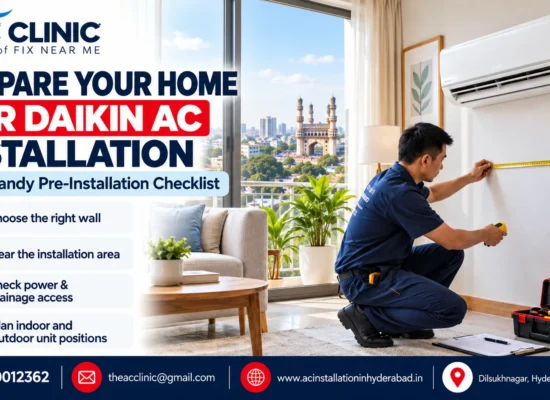
2. Choose a Suitable Indoor Unit Location
The indoor unit should be positioned to distribute cooled air effectively throughout the room.
Consider these factors before selecting the mounting location:
- Avoid positions where wardrobes, curtains or furniture obstruct airflow.
- Choose a structurally suitable wall that can support the unit.
- Avoid locations exposed to direct sunlight or nearby heat sources.
- Check that the installation allows convenient routing of refrigerant pipes and drainage.
- Ensure that the unit can be accessed for filter cleaning and maintenance.
The commonly mentioned 7–8-foot mounting height should not be treated as a universal specification. The manufacturer’s installation manual determines the required height and clearances for the particular model.
3. Plan the Outdoor Unit Location Carefully
Outdoor-unit placement can be more complicated in apartment buildings.
Depending on the building design, the outdoor unit may be installed on a designated balcony area, approved external platform or suitable mounting arrangement.
Before installation, consider:
Ventilation: The outdoor unit requires sufficient airflow to release heat. Avoid enclosed spaces or locations where hot air can circulate back into the unit.
Structural support: The floor, platform or mounting brackets must safely support the outdoor unit.
Neighbour disturbance: Consider compressor noise, vibration and hot-air discharge in relation to neighbouring balconies and windows.
Maintenance access: The outdoor unit should remain safely accessible for future servicing.
Weather exposure: Follow the manufacturer’s instructions regarding direct sunlight, rain exposure and protective covers. Do not obstruct the unit with an improvised enclosure.
Never place an outdoor unit on an unstable platform or an unsuitable balcony railing.
4. Understand Drainage Requirements
Split AC systems produce condensate during cooling.
This water must be directed away through an appropriately installed drain line.
In apartments, drainage planning is especially important because an incorrectly routed drainpipe can cause:
- Water dripping onto neighbouring balconies.
- Damp patches on external walls.
- Water accumulation near the installation area.
- Damage to interior finishes.
- Unpleasant inconvenience for other residents.
Ask the installation professional to identify a suitable drainage route before work begins.
The drainpipe should be installed with the slope and arrangement specified by the manufacturer. It should not discharge into an unauthorised common area or onto another apartment’s property.
5. Check Electrical Supply and Safety
Split AC installation requires appropriate electrical connections for the particular model and its rated capacity.
Before installation, the professional should assess:
- Available electrical supply.
- Required circuit capacity.
- Earthing arrangements.
- Suitable protective devices.
- Cable specifications.
- Power connection requirements.
Avoid using ordinary extension boards or unsuitable multi-plug adapters to operate an air conditioner.
Electrical wiring, circuit modifications and protective-device installation should be handled by a qualified electrical professional.
Do not attempt to open electrical compartments or modify AC wiring yourself.
6. Understand Refrigerant Piping and Installation Requirements
The indoor and outdoor units are connected through refrigerant piping and associated electrical connections.
The installation professional should follow the manufacturer’s instructions concerning:
- Permitted refrigerant pipe length.
- Pipe insulation.
- Pipe routing and bending.
- Drainage arrangement.
- Connections and leak testing.
- Vacuuming requirements.
- Refrigerant specifications.
- Final commissioning.
Incorrect installation can affect cooling performance and may create refrigerant leakage or other operating problems.
Refrigerant handling, pressure testing, vacuuming and leak diagnosis should be left to appropriately qualified professionals.
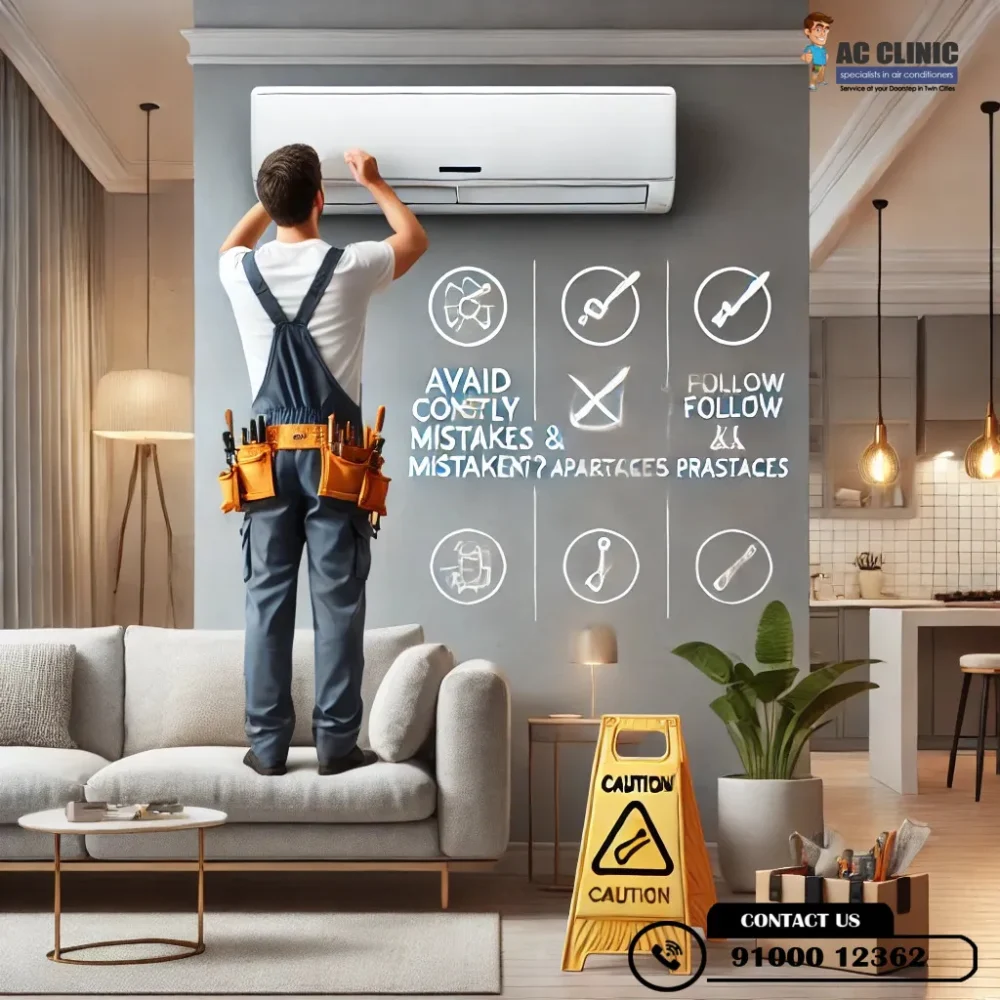
7. Common Mistakes to Avoid During Apartment AC Installation
Mistake | Possible consequence |
Installing without checking building permission | Disputes or required removal |
Choosing an unsuitable indoor-unit location | Poor airflow distribution |
Placing the outdoor unit in a confined area | Restricted heat dissipation |
Using weak mounting support | Vibration or structural risk |
Incorrect drainpipe routing | Water leakage and inconvenience |
Ignoring electrical requirements | Electrical hazards |
Poor pipe insulation | Condensation and efficiency problems |
Blocking outdoor-unit ventilation | Reduced operating performance |
Ignoring maintenance access | Difficulty during future servicing |
A proper installation plan should address these concerns before drilling or mounting begins.
8. What Should You Check Before the Installation Professional Leaves?
After installation, ask the professional to demonstrate that the system is operating correctly.
Use this checklist:
- Indoor unit is securely mounted.
- Outdoor unit has stable support.
- Airflow around both units is unobstructed.
- Condensate drainage has been checked.
- Refrigerant connections have been checked for leakage.
- Electrical connections have been inspected.
- The system has been operated and tested.
- Unusual vibration or noise has been investigated.
- Remote-control functions have been demonstrated.
- Installation documentation and applicable warranty information have been explained.
Keep the manufacturer’s installation documents and purchase information for future reference.
9. Does Apartment AC Installation Require Special Planning?
Yes. Apartment installations can involve additional coordination compared with independent houses.
The main differences are usually:
Consideration | Independent house | Apartment |
Outdoor-unit location | More placement flexibility, subject to safety | May be restricted by building design |
External drilling | Property-specific approval | May require association or landlord approval |
Drainage | Property drainage arrangement | Must avoid affecting neighbouring properties |
Noise | Household and neighbourhood considerations | Additional consideration for nearby residents |
Maintenance access | Property-specific | May involve shared or restricted spaces |
The exact requirements depend on the building, apartment rules and AC model.
Frequently Asked Questions
1. Can I install a split AC in an apartment?
Yes, provided a suitable indoor and outdoor unit location, drainage arrangement and electrical supply are available. Check applicable apartment and landlord permissions before installation.
2. Where should the outdoor AC unit be installed in an apartment?
It should be placed in an approved, stable and adequately ventilated location with sufficient maintenance access. The manufacturer’s clearance specifications must be followed.
3. Can an AC outdoor unit be installed on a balcony?
It may be possible if the balcony arrangement is suitable and permitted by the apartment management or property owner. Structural support, ventilation, drainage and neighbour disturbance must also be considered.
4. What happens if the AC drainpipe is installed incorrectly?
Incorrect drainage can result in water leakage, dampness and water dripping into neighbouring spaces. The drainage route and slope should be checked during installation.
5. How much clearance is required around a split AC?
Clearance requirements vary by model. Refer to the manufacturer’s installation manual rather than relying on a universal measurement.
6. Should I hire a professional for split AC installation?
Professional installation is advisable because refrigerant piping, electrical connections, drainage and system commissioning require appropriate technical knowledge and equipment.
7. Can tenants install split AC units in rented apartments?
Tenants should first obtain permission from the property owner, particularly when drilling, external mounting or permanent modifications are involved.
Final Checklist Before Booking Your AC Installation
Before confirming the installation, make sure you have:
- Checked apartment association or landlord permissions.
- Selected a suitable indoor-unit location.
- Confirmed an approved outdoor-unit location.
- Planned the drainage route.
- Checked electrical supply requirements.
- Confirmed installation requirements for your AC model.
- Discussed additional materials and installation charges.
Good preparation can help prevent avoidable installation problems and make the process more organised.
Need Split AC Installation Assistance in Hyderabad?
AC CLINIC provides doorstep AC installation services in Hyderabad, subject to service availability.
If you need installation assistance for your apartment, contact the team to discuss your AC model, installation requirements and location.
Phone: 9100012362
Email: theacclinic@gmail.com
AC CLINIC is a service brand of FIX NEAR ME. Services are provided at customers’ locations; AC CLINIC does not operate a separate physical service centre. Service availability should be confirmed before booking.